Urban Socio-Semantic Segmentation with Vision-Language Reasoning
Urban Socio-Semantic Reasoning in 1080P: SocioReasoner bridges digital street maps and high-resolution Earth observation with vision-language reasoning. Gliding the interactive divider reveals satellite imagery, on which the vision-language reasoning policy illuminates the precise socio-semantic segmentation mask matching textual POIs and commercial functional zones.
Abstract
Method Overview
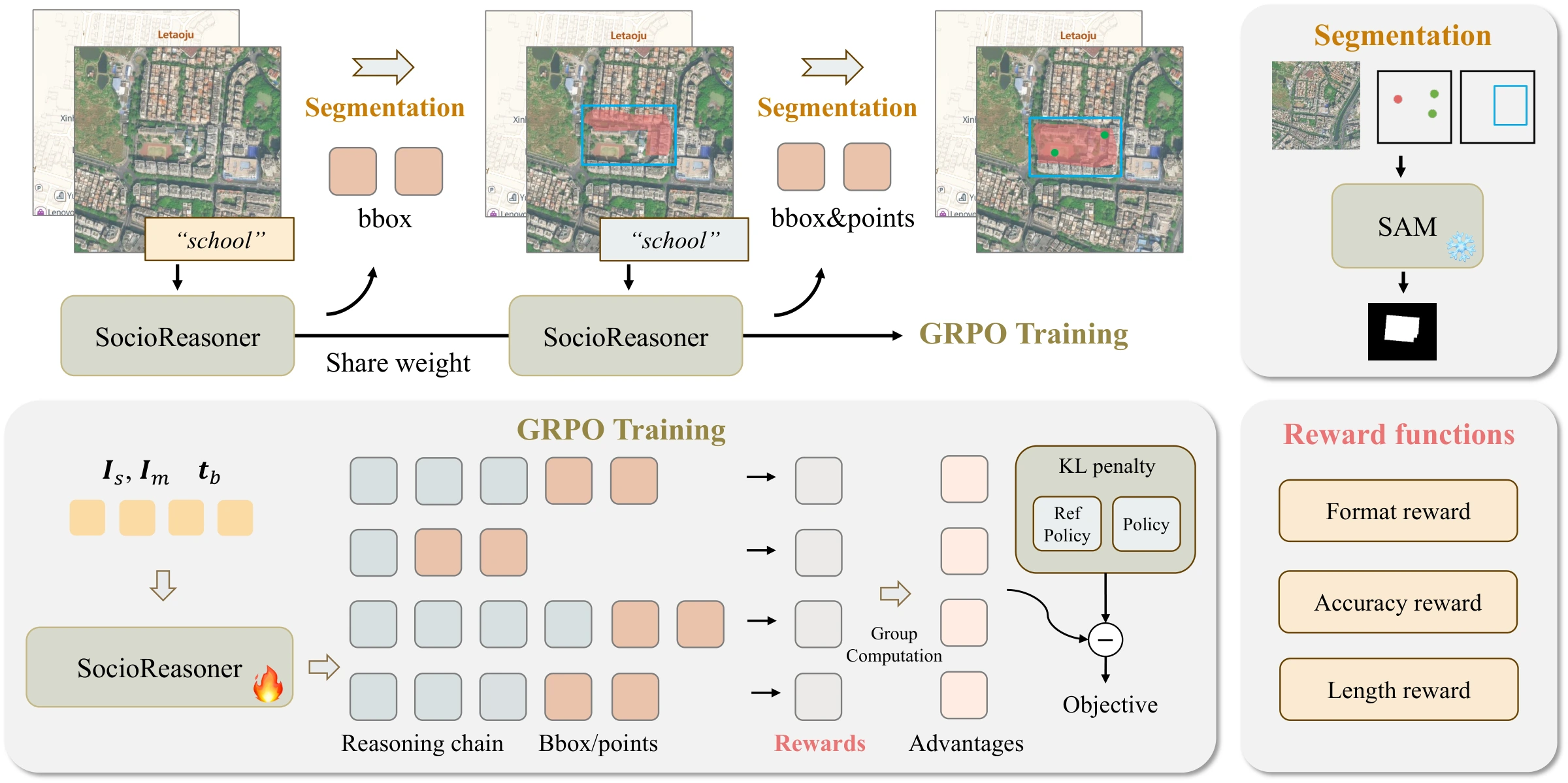
The Overall Architecture of SocioReasoner: Given high-resolution satellite imagery, an aligned OpenStreetMap digital block map, and natural language instructions, the Vision-Language Model (VLM) first produces coarse bounding boxes to localize candidate functional regions. These boxes guide the Segment Anything Model (SAM) to generate an initial coarse mask. The synthesized predictions are iteratively re-rendered and overlaid onto the visual inputs, enabling the VLM to reflect, verify, and emit refined point-and-box prompts for final high-fidelity mask synthesis. The multi-stage prompt generation policy is trained end-to-end via Group Relative Policy Optimization (GRPO).
Quantitative Results
| Method | Socio-name cIoU | Socio-name F1 | Socio-class cIoU | Socio-class F1 | Socio-function cIoU | All cIoU | All gIoU | All F1 |
|---|---|---|---|---|---|---|---|---|
| UNet | 10.9 | 8.0 | 12.6 | 11.2 | 11.1 | 11.7 | 10.7 | 10.0 |
| Segformer | 22.0 | 18.1 | 22.4 | 19.5 | 21.4 | 22.1 | 20.5 | 18.7 |
| SegEarth-OV | 3.3 | 0.0 | 3.8 | 0.0 | 4.2 | 3.7 | 3.7 | 0.0 |
| RSRefSeg | 27.1 | 30.9 | 30.7 | 35.3 | 28.7 | 29.0 | 28.3 | 32.8 |
| SAM-R1 | 25.6 | 37.2 | 22.3 | 32.1 | 17.7 | 22.5 | 23.7 | 32.4 |
| Seg-R1 | 46.0 | 50.4 | 40.4 | 45.2 | 34.5 | 41.0 | 45.0 | 45.2 |
| RemoteReasoner | 46.6 | 56.1 | 42.9 | 53.9 | 38.0 | 43.2 | 47.7 | 53.3 |
| VisionReasoner | 48.5 | 58.4 | 44.4 | 55.5 | 36.3 | 44.0 | 48.5 | 54.3 |
| SocioReasoner (Ours) | 52.6 | 64.6 | 47.6 | 60.1 | 40.6 | 47.9 | 52.8 | 59.7 |
Qualitative Demos
Citation
@inproceedings{wang2026socioreasoner,
  title={Urban Socio-Semantic Segmentation with Vision-Language Reasoning},
  author={Wang, Yu and Wang, Yi and Dai, Rui and Wang, Yujie and Liu, Kaikui and Chu, Xiangxiang and Li, Yansheng},
  booktitle={International Conference on Learning Representations (ICLR)},
  year={2026}
}